Basic DIY Profit & Loss Template
(Google Sheets)
Disclaimer
This DIY Basic P&L Google Sheet, including all worksheets, formulas, instructions, and related materials, is provided by Check Bookkeeping, LLC for general educational and informational purposes only.
This spreadsheet is not individual financial, accounting, tax, legal, investment, or business advice. It is not designed to replace professional bookkeeping, accounting, tax, legal, or financial services and does not take into account your specific circumstances.
The calculations, reports, totals, and outputs generated by this spreadsheet are based solely on the information entered by you and the formulas included in the template. Results may be incomplete, inaccurate, or unsuitable for your situation. Check Bookkeeping, LLC does not guarantee that the spreadsheet will be error-free or that it will identify every financial transaction, classification issue, bookkeeping error, or reporting requirement.
You are responsible for reviewing your entries, confirming the accuracy of the formulas, and determining whether the information is appropriate for your business. You should consult with your own CPA, bookkeeper, attorney, or other qualified professional before making financial, tax, legal, investment, or business decisions.
By downloading or using this spreadsheet, you acknowledge and agree that Check Bookkeeping, LLC is not responsible for any decisions you make, losses you incur, errors in your records, or results you achieve based on your use of the spreadsheet.
Real estate investing and business ownership involve financial risk, including the possible loss of capital. No spreadsheet, template, or bookkeeping system can guarantee profitability, tax savings, compliance, or any specific financial outcome.
About Us

By entering your information, you acknowledge the disclaimer and you’ll receive this free resource and be subscribed to receive occasional marketing emails from Check Bookkeeping. You can unsubscribe at any time.
You acknowledge that this download is for general information and operational use only. It is not legal, tax, or accounting advice. Always consult your tax advisor for guidance specific to your situation.
About Check Bookkeeping, LLC
We are Built for Real Estate Investors and Contractors. Backed by Discipline.
At Check Bookkeeping, we help real estate investors and contractors stop stressing over missed opportunities and start focusing on what matters—building profitable projects and long-term wealth.
Founded by Cameron Jones, a QuickBooks Certified ProAdvisor and fitness enthusiast who believes in hard work, consistency, and showing up—both in the gym and in business—Check Bookkeeping brings the same level of discipline to your books.
Messy financials? Missed deadlines? Overdue 1099s? We’ll handle it.
We help real estate investors and contractors in NYC and nationwide take control of their finances, clean up their records, and stay tax-ready—without the stress.
For Contractors
We help general contractors, remodelers, roofers, HVAC technicians, electricians, subcontractors, and owner-operators organize QuickBooks, track job profitability, improve cash-flow visibility, and stay ready for tax season.
The Profit and Loss Statement (P&L) is one of the four core financial statements produced by New York bookkeepers to provide the entrepreneur with a clear snapshot of the company's financial performance. It is also referred to as the Income Statement, and is the go-to financial report for NYC entrepreneurs. Three ways that your Profit and Loss statement can be optimized is by tracking income by it’s source, tracking by location, and using Products and Services to accurately track job costing for your real estate business.
Whether you’re looking for the “best New York bookkeeper” or searching for a “bookkeeper near me”, it is important to find one that will help you understand your profit and loss so you can make informed decisions to improving your business’s success.
What Does the Profit and Loss Statement Include?
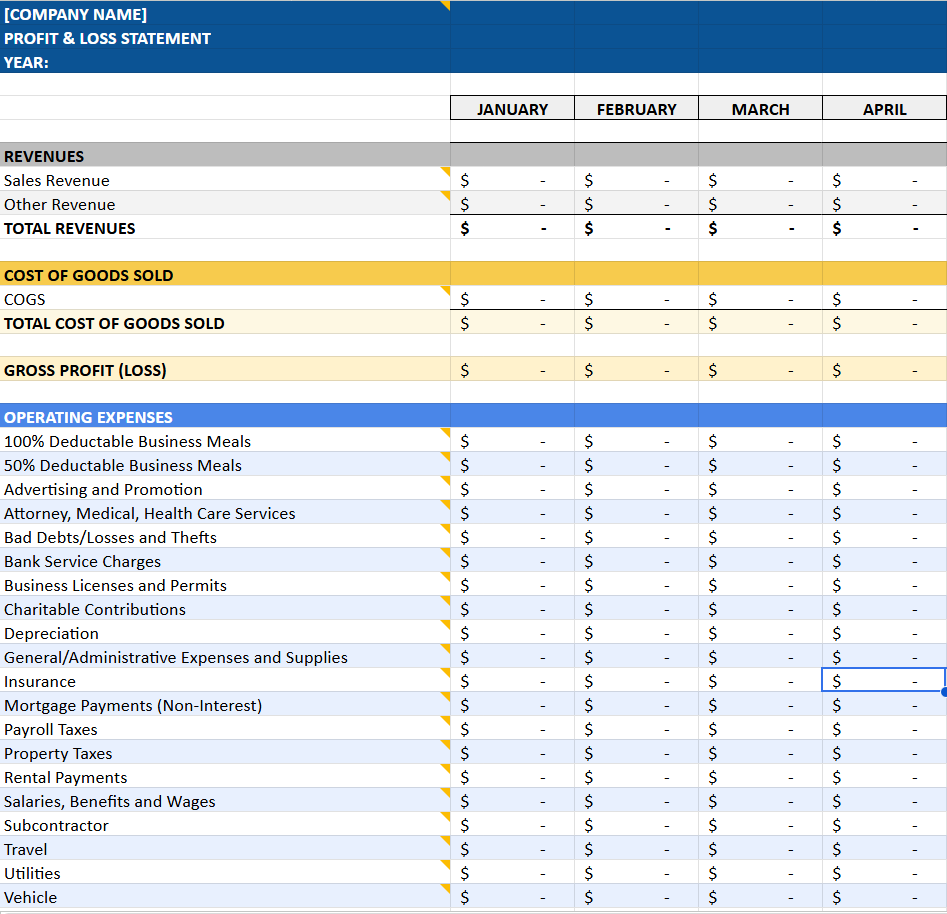
The Profit and Loss statement tracks the following key financial data:
Revenue sources
Cost of Goods Sold (COGS)
Payroll expenses
Advertising expenses
Interest and tax expenses
Other business expenses
Profit and Loss Calculations For Key Performance Indicators
As you make your way down the Profit and Loss statement, you will find the following calculations to yield key performance indicators (KPIs) to help you with budgeting and determining your bottom-line.
The calculation starts with:
Revenue - COGS = Gross Profit
Next, you will find your Net Operating Income which takes into account all other operational expenses such as marketing, payroll, and others, however, it does not include Interest and Taxes:
Gross Profit - Operating Expenses = Net Operating Income
Finally, you will find your Net Income which takes account of your Financing Expenses, such as Interest and Taxes:
Net Operating Income - Financing Expenses such as Interest and Taxes = Net Income
However, it is important to note that Net Income doesn’t always equal your net cash flow. Here's why:
Accrual Accounting for NYC Entrepreneurs
If your business uses accrual accounting, your Net Income will include all income sources, such as cash payments and accounts receivable (outstanding invoices). Accounts receivables are not cash yet, however, they are accounted for in your Net Income at sale.
Unearned Revenue and NYC Entrepreneurs
Unearned revenue, a liability in your chart of accounts, can increase your cash balance but doesn’t impact your income until the job is completed. This is when you receive payment before the job was completed.
For example, if an NYC HVAC technician receives a $1,000 prepayment for an air conditioning repair, they would record the transaction as:
Debit Cash $1,000, Credit Unearned Revenue $1,000.
Upon completing the repair, they recognize the revenue:
Debit Unearned Revenue, Credit Sales Revenue.
Why is the Profit and Loss Statement Important for NYC Entrepreneur?
Most NYC entrepreneurs start their businesses to generate a profit and sustain their livelihood. The Profit and Loss statement helps NYC entrepreneurs determine if their revenues are exceeding their expenses during a given period.
New NYC entrepreneurs can easily encounter cash flow issues, so it's important to have a bookkeeping system that provides a clear, easy-to-review breakdown of all expenses. This allows them to identify profitable revenue sources and pinpoint unnecessary expenses that can be reduced to improve their bottom line.
Optimize Your Profit and Loss with Professional New York Bookkeeper
A savvy NYC entrepreneur providing multiple services in various locations should work with an experienced New York bookkeeper to optimize their Profit and Loss. A professional, especially one certified as a QuickBooks Online ProAdvisor, can streamline the categorization of revenues and expenses, making the Profit and Loss statement a strategic tool for growth. Here are three strategies you can use in order to optimize your Profit and Loss Statement:
1. Revenue Categorization for Multi-Source Income
If your business generates revenue from multiple sources (e.g., brand merchandise sales, business coaching, a YouTube channel, etc.), a skilled New York bookkeeper can categorize incoming revenue into distinct groups. This allows you to track various income streams so you can compare and contrast to see which services are generating the most profit.
2. Tracking Business Performance by NYC Boroughs
If your business operates in multiple locations (e.g., Manhattan, Queens, Brooklyn, Staten Island, and/or The Bronx), you can leverage the Class or Location Tracking feature in QuickBooks Online to attribute sales to specific stores or locations. This unlocks enhanced reporting potential so you can make strategic decisions for certain locations, such as:
Increasing personnel in high-performing stores
Reallocating advertising budgets to low performing stores
3. Using Products and Services In QuickBooks Online For Job Costing For NYC Real Estate Businesses
If you are a real estate investor such as a fix and flipper, short term rental property owner, or long term rental property owner—tracking job costs is crucial for managing your bottom line. You can achieve this by using Products and Services in QuickBooks Online, linking them to specific Cost of Goods Sold (COGS) accounts. Proper tracking of these transactions enables real-time financial reporting, helping you stay on top of project costs.
Some examples of cost codes that can be used include:
Permits
Rough Plumbing
Roof and Siding
HVAC
Flooring
Bathrooms
Kitchen Decor
This process is highly complex and demands meticulous attention to detail, along with technical expertise from a skilled New York bookkeeper experienced in QuickBooks Online. Errors can result in inaccurate financial reports.
New York Bookkeepers Provide Comprehensive Expense Categorization
Accurate categorization of expenses ensures your profit and loss delivers actionable insights. For example:
If you spent $5,000 on advertising, you can use your profit and loss statement to determine whether the investment is generating sufficient return on investment (ROI) or if adjustments are needed.
NYC Entrepreneurs Using the Profit and Loss for Financial Analysis
A strategically formatted profit and loss statement is invaluable for conducting financial analysis. You can:
Compare performance over time: Use horizontal analysis to compare revenue and expense trends year-over-year (e.g., 2024 vs. 2023) or month-over-month (e.g., June vs. May).
Assess the impact of changes: Identify how new business strategies affect your bottom line. For example, how did updates to New York business law affect your business?
Tax Preparation and the Profit and Loss Statement
The Profit and Loss statement is indispensable for filing taxes, especially for NYC entrepreneurs who need to complete a Schedule C. A well-organized Profit and Loss statement:
Simplifies tax preparation by providing a detailed breakdown of income and expenses.
Ensures an optimized tax return by categorizing deductible expenses properly.
Serves as a reliable audit trail for IRS compliance.
Free Resources and Support
New NYC entrepreneurs, I’ve created a simple Profit & Loss Tracker on Google Sheets. Don’t leave without your free download! Enter your email address below to get access to the Do It Yourself Bookkeeping Tracker!
By entering your information, you acknowledge the disclaimer and you’ll receive this free resource and be subscribed to receive occasional marketing emails from Check Bookkeeping. You can unsubscribe at any time.
You acknowledge that this download is for general information and operational use only. It is not legal, tax, or accounting advice. Always consult your tax advisor for guidance specific to your situation.
